Getting to know virtual reality (VR) is quite a hassle - you need to carve out at least half an hour or an hour for the session itself, get to the VR club, pay about (minimum!) $10-20... This is understandable: the simplest VR club needs space and investments of no less than $10,000 in personnel, so it is aimed at working "wholesale" for hours.
But is it possible to introduce people to VR "retail", minute by minute, in crowded places, like street musicians introduce people to music? Accordingly, ("retail" and "with delivery"!), the price per minute of viewing can be significantly higher than the "club" price. The latter is easy to google and makes up a pretty decent $20-$30 for half an hour/hour.
I am proposing a business concept based on a "VR mini-club" (VRMC) that utilizes a standalone headset and my 3D drone videos. It functions as a "Feel Like a Giant" attraction, allowing the viewer to experience the sensation of being Gulliver in Lilliput while watching soothing, relaxing footage of various landmarks that appear as massive toys in 3D. These short clips—lasting between 30 seconds and a minute—are perfect for filling brief intervals of time with a unique, pleasant experience. More precisely, this is TR—Transformed Reality (or Magic Scale Mode); it looks more natural than the typical "plastic" VR look, yet it cannot be seen with the naked eye. Consequently, our "club" can be referred to by either the acronym VRMC or TRMC.
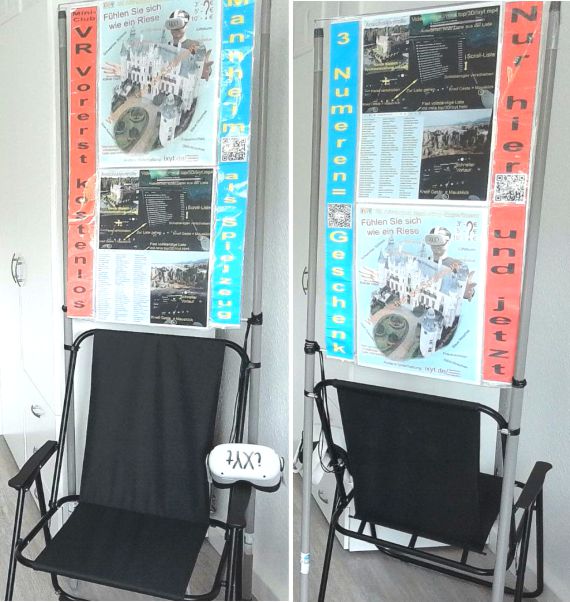
This model allows for the creation of jobs at a startup cost of just $500–$700 and enables the retail sale of VR experiences—in 3, 5, or 10-minute sessions—in a wide variety of locations: train stations, shopping malls, on the street, or even on a tram. It also supports mobile operations, such as visits to children's parties, corporate events, or private birthday celebrations. The equipment required is minimal: the headset itself, a sanitizer with wipes, and a folding chair that doubles as a stand for posters—one to draw people in (see the photo below) and another displaying instructions on how to control the viewing experience.
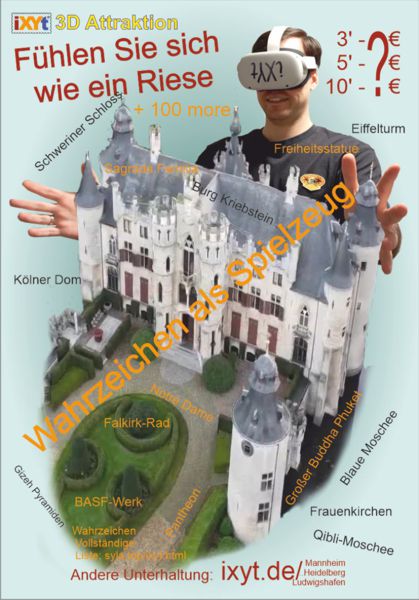
I can help by providing image files in the required language—ready for printing and laminating on-site—since I find it hard to imagine attracting customers without them. Unless, of course, you have children of the right age who are eager to try their hand at business among their peers; kids find it easy to connect with other children. That said, I do wonder how tax authorities and the general public in different countries view this sort of thing.
If you have a headset like the Quest 2, 3, or 3S and a suitable location with a good internet connection, you can test this idea in practice. I have been regularly uploading videos with a resolution of 1280x720 per eye for over three years now to:
This creates the visual effect of a 100-inch screen inside the headset without significant pixelation.
In other words, a relatively simple and affordable headset delivers an impressive effect: trees appearing as tiny bonsai, peoples' figures smaller than matchsticks, all set within familiar or new, highly detailed, 3D "toy-like" landscapes.
If the business takes off, I can supply—via franchise—videos in 1920x1080 resolution for standalone operation without Wi-Fi.
There are already over 200 of these videos, offering two to three hours (or more) of continuous viewing.
Here is the Mannheim Water Tower—the city's landmark—rendered in a simplified "3D" style for a standard monitor. When viewed through a headset, the image remains steady and appears to be two meters tall. You can also take a quick look at the famous Neuschwanstein Castle, Margam Castle or the Mannheim Baroque Palace, the second-largest of its kind in Europe.
Unfortunately, people in my hometown of Kharkiv have little interest in virtual reality right now, and in Germany—where I find myself without German language skills—conducting a serious marketing experiment is nearly impossible. By the way, I would welcome a German-speaking partner living near Mannheim who is interested in helping with testing. If successful, I guarantee significant discounts and perks—we can work out the details.
Under the auspices of
Neue Zeiten e.V., I also offer clients a souvenir booklet featuring 3D city views, complete with anaglyph glasses, for a donation of just 2 euros. This unique, affordable souvenir serves as an excellent, low-key promotional tool for travel agencies, hotels, cafés, or other future partners of the MKTR project (the booklet is easily branded with a sticker or by inserting the establishment's flyer). Naturally, the glasses can be used to view not only these specific clips but also hundreds of others from the @ixyt channel’s anaglyph playlist and similar YouTube channels.
The initial version of the MKVR/MKTR described above was far from ideal: it was difficult to make the chair-and-poster setup wind-resistant, and people were put off by the complex controls and the headset itself, which made them feel they were losing control.
The updated version of the MKTR gives the client a choice: view the content via the headset on a large screen or through the
Qoocam-viewer viewer, which has a smaller—but brighter and sharper—screen. I have now loaded 12–15 of the most engaging clips onto both devices, set to loop automatically. This eliminates the need to teach newcomers how to operate the controls.
The photos (clickable) in the gallery below illustrate the TRMC’s activities at a local festival in Mannheim—despite temperatures exceeding 30°C (with the exception of the first shot, which shows an older version).


Page
1 of 1
The first minute of viewing is free; for the subsequent minutes, I ask for a donation to *Neue Zeiten e.V.*—an amount of your choice. Naturally, the results of short-term or sporadic experiments offer limited insight.
There is also no guarantee that the results can be replicated in other locations; however, this presents an opportunity for you to launch a new revenue stream near your home (or right inside it, or within a business such as a massage or tanning salon, a pool hall, a café, or a hotel). If successful—and depending on local conditions—this venture could clearly be scaled up by hiring staff to manage key locations. Both I and
Neue Zeiten e.V. are ready to assist in creating promotional brochures for your location using stills from the relevant videos or—for standard VR arcades, escape rooms, or similar venues—using 3D imagery of your attractions that you provide.
For my part, I offer support by providing 3D videos of local landmarks (you can request these by commenting on any video at youtube.com/@ixyt), printable image files in your language, or by listing your mobile VR unit’s schedule and address on the page ixyt.info/en/COUNTRY/CITY.
I therefore invite owners of Oculus Quest 2, 3, or 3S headsets to replicate my experiment in their own cities and share the results with me.
The easiest way to do this is by enabling hand tracking (controller-free mode), switching the headset to "travel mode," and using the videos on my channel at deovr.com/channel/anatolazarenko; the platform's player allows you to skip uninteresting clips without exiting and subsequently wandering through YouTube's recommended videos. In addition to an image showing headset controls, users can watch a short video demonstrating basic operations at mria.top/3D/ixyt.mp4.
The new posters attach easily and securely to a pole using an X-banner stand. Such stands are convenient for indoor use, and I am seeking partners to test this attraction in various types of shopping and entertainment venues—see the image on the left.
Interactive world map with markers for locations viewable via "Giant's Eyes" in SBS format (for VR headsets) —
HERE (as of July 31, 2026)
Collaboration Proposals
1. For distributors of VR and 3D video content:
We can produce any combination of 3D clips from the @ixyt channel in HD or higher resolution, featuring your choice of audio or logos—please propose your terms.
2. We can create sets of 3D booklets (including anaglyph glasses) based on frames from our library of over 200 videos of landmarks worldwide, or using 3D frames, video clips, or Google Earth data provided by you.
3. We are looking for affordable, compact vending machines for souvenir booklets (dimensions: 210x110x4 mm; weight: approx. 30g) that are easy to reconfigure, thereby freeing the kiosk operator from the hassle of handling them. 4. Manufacturers of microdisplays, AR/VR glasses, headsets, or HMDs: a pair of displays with lenses is needed, driven by a single-board computer or controller to play back pre-loaded video clips via external controls, all housed in a binocular-style casing. In other words, a combination of a View-Master-style viewer and a headset—stripped of superfluous accelerometers and controllers—serving as the basis for a convenient, low-cost retail station for selling VR content and souvenirs.
5. The setup described in point 4 implemented as a vending kiosk (like a Euroscope), located next to or integrated into the same unit as the system from point 3—who is interested in participating?
You can comment and ask questions here or under the video on the
DeoVR or
YouTube channels: